The Fishing Cooler Has a Different Job Than the Camping Cooler — Why They're Not the Same Product
Walk into any outdoor gear shop and you’ll find the coolers grouped together in one section. Hard-sided boxes in various sizes, different colors, a range of price points. The product descriptions mention ice retention, capacity in quarts or liters, and sometimes the number of days the ice supposedly lasts. What they rarely mention is what you’re actually planning to do with the cooler — and why that matters more than most people realize when they’re choosing between options.
A fishing cooler and a camping cooler are both hard-sided insulated boxes. They look similar. They serve adjacent purposes. But what they’re asked to do over the course of a day or a weekend is different enough that treating them as interchangeable leads to regular frustration.
What a Fishing Cooler Is Actually For
The primary job of a fishing cooler is preserving the catch. That means temperatures cold enough to slow bacterial growth in fish — ideally 0 to 2°C — for the duration of a fishing trip, which might run from before dawn to late afternoon on a boat or a frozen lake.
Fish need to be kept colder than most food items. The enzymes that cause quality degradation in fish are active at temperatures that would be fine for vegetables or even meat. A cooler that holds its temperature at 5°C is adequate for a camping food supply; it’s marginal for fresh fish that you’re planning to eat or take home.
The other distinctive requirement is that fishing coolers get wet, repeatedly, in ways that camping coolers don’t. Bait — minnows in water, worms in damp bedding, cut bait that bleeds — creates moisture and odor inside the cooler. Fish taken out of the water go into the cooler. Ice melt accumulates. Salt water gets introduced if you’re ocean fishing. A cooler used primarily for fishing needs to drain easily, seal well enough to contain liquids and odors, and clean completely without leaving residue in corners and seams.
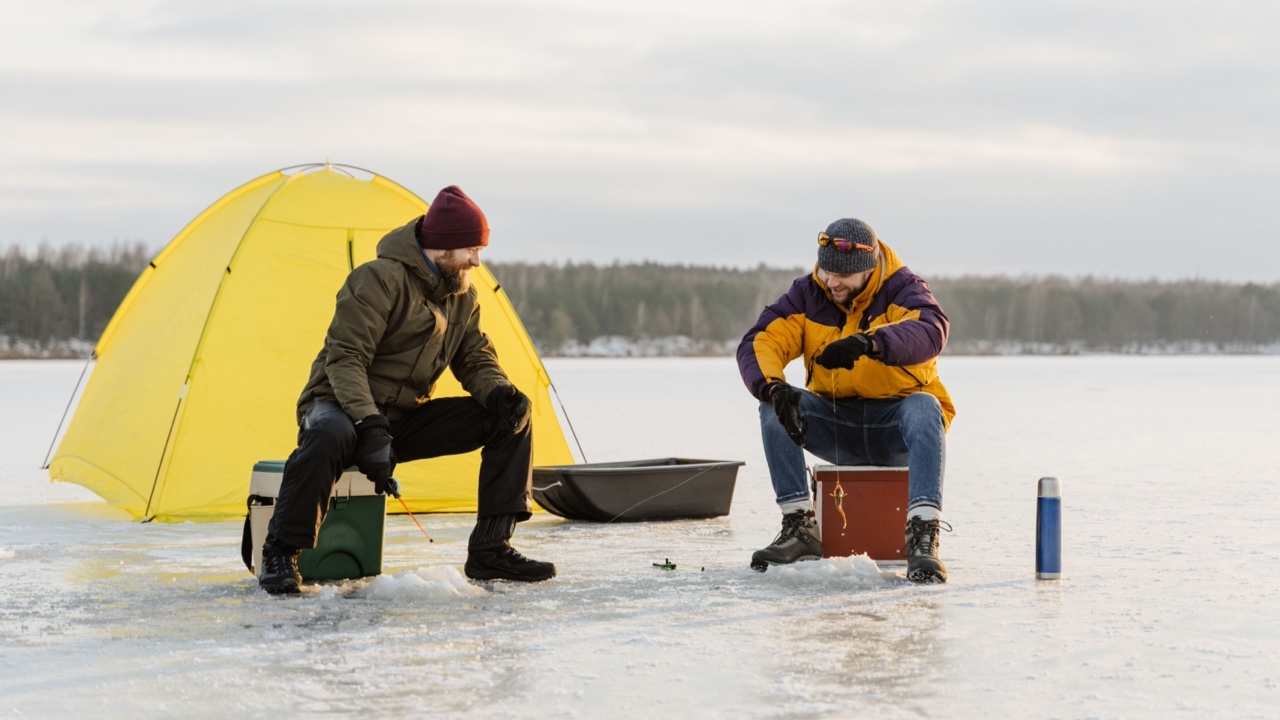
Many fishing coolers are also used as seats. Ice fishing in particular — where you’re sitting on a frozen lake for hours — makes the lid a functional chair. A cooler that can support two hundred pounds on the lid without cracking, flexing, or compromising the seal is a specific structural requirement that has nothing to do with food storage.
What a Camping Cooler Is Actually For
The camping cooler has a different set of priorities. Its primary function is food storage across multiple days in a field environment without access to refrigeration. This means ice retention over forty-eight to seventy-two hours or longer is the most important variable — cold enough for food safety across the full duration of the trip, not just the first day.
Camping coolers typically hold a much wider variety of items than fishing coolers: raw meat, dairy, condiments, prepared foods, beverages, produce. These items have different temperature sensitivities, different packaging, and different access patterns. You’ll open a camping cooler many times per day — for meals, for drinks, for snacks — which means the cooler has to manage its temperature even as warm air enters repeatedly.
Organization matters in a way it doesn’t for a fishing cooler. Camping coolers often need to accommodate items of varying size and shape, keep dry items dry when ice melts, and allow retrieval of specific items without unpacking everything above them. Drain plug placement matters for easy drainage without tipping the whole cooler.
Weight and portability also play differently. A fishing cooler might travel from car to boat or truck bed and stay there for the day. A camping cooler might need to be moved multiple times, carried over uneven terrain, or loaded in and out of a vehicle repeatedly. For the same volume, a lighter cooler is more useful in a camping context than a fishing one.
Where They Converge and Where They Don’t
Both categories need good insulation, durable construction, and latches that hold securely. Rotomolded polyethylene is the construction method that best serves both — a single-piece rotationally molded body has no seams to crack, fail, or harbor bacteria, and the thick walls that result from the process provide excellent insulation alongside genuine structural strength.
Where they diverge is in the specifics of how that insulation and construction is configured.
A fishing cooler benefits from a full-perimeter gasket that seals tightly enough to contain fish odor — not just to keep cold in, but to keep smell from permeating the interior. It benefits from a textured lid surface that provides grip when used as a seat and a load-rated lid that won’t deform under sustained weight. It benefits from drain plugs positioned to allow complete drainage without tipping, and an interior that’s smooth and light-colored for easy inspection and cleaning after use.
A camping cooler benefits from longer ice retention over the full multi-day duration, even at the cost of some additional weight. It benefits from a wider interior footprint that accommodates standard-size containers and bottles standing upright. It may benefit from integrated cup holders, bottle openers, or tie-down points that make it more useful at a campsite as a piece of furniture rather than just a storage container.
These aren’t dramatic differences, but they’re meaningful ones. A fishing cooler used as a camping cooler works, but it might drain in an inconvenient location, lack the organizational features that make multi-day food management easier, and have a lid that’s optimized for structural integrity over ease of access. A camping cooler used for fishing works, but might not seal well enough to contain fish odor, might be harder to clean completely, and might not be rated for sitting on.
What This Means for Buyers
For outdoor retailers, specialty shop buyers, or organizations sourcing coolers at volume for a specific customer base, the distinction matters because it determines which product actually serves the end user well — and which one generates returns, complaints, or simply gets abandoned after a season because it never quite fit the use.
A fishing guide operation that buys thirty coolers for a fleet of boats has different requirements than a glamping resort that equips each cabin with a cooler for guests. An outdoor gear subscription box targeted at anglers needs a different product than one targeted at weekend campers. The exterior dimensions and price point might be identical; the functional specifications are not.
When sourcing ice cooler bulk orders, the right questions aren’t just about capacity and ice retention hours — they’re about what the cooler is being used for, by whom, under what conditions, and how often it will be cleaned, transported, and asked to do things beyond holding cold food. A manufacturer who can specify drain plug placement, lid load rating, gasket seal type, and interior surface material for different product lines is one who understands that fishing and camping aren’t the same market, even when both come in at 45 quarts.
The Simpler Version
If you fish seriously, you need a cooler built for fish — heavy-duty enough to sit on, sealed well enough to manage bait smell, and easy enough to clean that you’ll actually clean it after every trip. If you camp seriously, you need a cooler built for multi-day food management — organized, efficient on ice over the full trip duration, and convenient enough to use repeatedly throughout the day without feeling like a logistics problem.
The good news is that both exist. The useful habit is knowing which one you’re shopping for before you start comparing prices on features that don’t apply to your situation.