The Case for Buying One Good Blanket Instead of Several Cheap Ones
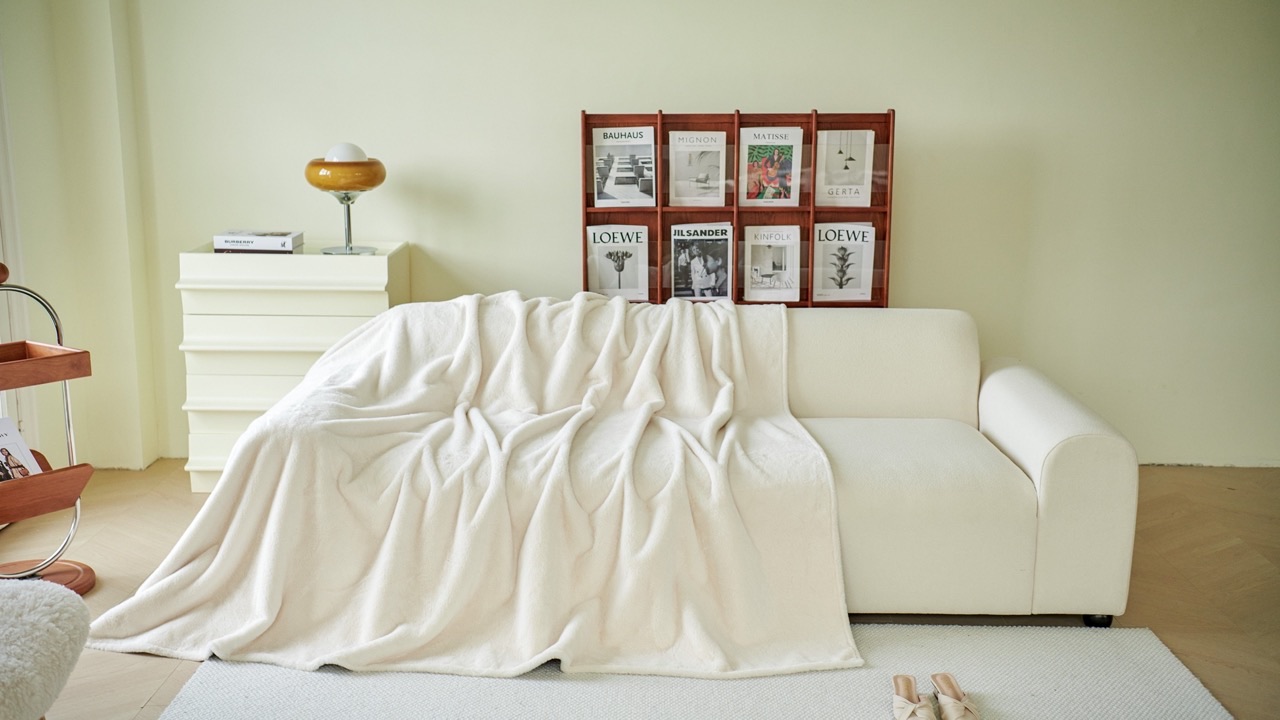
I’ve gone through the cheap-blanket accumulation cycle more than once. You buy a $25 fleece throw because it’s on sale, it pills within a year, you push it to the back of the closet, you buy another one. Three years later you have four mediocre blankets that you rotate through without being particularly happy with any of them, and the total you’ve spent is more than one decent blanket would have cost.
This is a pattern that applies to a lot of things, but it shows up especially clearly with blankets because the quality gap between a cheap one and a well-made one is immediately obvious if you’ve ever spent time under both.
What cheap blankets actually cost over time
A $25 acrylic throw lasts, in my experience, about one to two years before it’s pilled enough to be noticeably unpleasant. Some last longer if they’re washed carefully and used infrequently, but in regular daily-use conditions — on a couch, picked up and put down a dozen times, washed every few weeks — they degrade fast. The surface texture changes, the material starts to feel slightly sticky in warm weather, and the color loses whatever depth it had.
If you replace a $25 blanket every two years, you spend $12.50 per year on blanket coverage. A $250 wool blanket that lasts 20 years costs the same amount per year. Except it doesn’t just cost the same — it performs better throughout. The comparison isn’t even equivalent; you’re getting a categorically different experience for the same annual spend.
There’s also the friction cost: the time spent noticing that the current blanket is bad, deciding to replace it, actually going to replace it, and then waiting for the new one to arrive. Do that five times over a decade and you’ve spent meaningful time and mental energy on a purchase cycle that a single better decision could have eliminated.
The performance gap that math doesn’t capture
The financial case for buying quality over quantity is straightforward enough, but it undersells the actual difference in experience. Cheap acrylic blankets and quality wool blankets are not the same product at different price points. They’re different products.
A well-made wool blanket regulates temperature in a way synthetic blankets don’t. Wool fibers absorb and release moisture as humidity changes, which means a wool blanket stays comfortable across a wider range of temperatures instead of feeling stuffy when you’re warm and not warm enough when you’re cold. Synthetic materials don’t do this — they trap heat or fail to retain it, depending on the fiber, and they don’t breathe.
Wool also softens with use rather than degrading. A new wool blanket can feel slightly coarse; the same blanket after a few years of washing and use will feel noticeably softer as the lanolin distributes and the fibers settle. Cheap acrylic goes in the opposite direction — it starts as acceptable and gets worse. The trajectory matters if you’re planning to keep something for a long time.
The clutter argument
There’s a dimension to buying quality over quantity that isn’t about money at all. Four mediocre blankets in a closet represent four decisions you need to make: which one to use, which one to wash, whether to keep them all or get rid of some. One good blanket you actually like eliminates that category of decision-making entirely.
This is one of those observations that sounds abstract until you experience the specific relief of having a home where every object in it is something you chose deliberately rather than something you accumulated. The closet that has one blanket you love is more useful — practically, not just aesthetically — than one with four you’re ambivalent about. You always know where it is, you always use it, and you don’t spend any time managing the others.
What makes something worth the price
Not every expensive blanket is worth its price, which is worth acknowledging. A brand selling cheap acrylic at a premium price point because the packaging is nice isn’t the same as a brand selling quality materials and construction. The price is not the differentiator; the materials and craftsmanship are.
For wool blankets specifically, the markers that correlate with actual longevity and performance: the fiber type is specified (Merino, lambswool, a named breed rather than just “wool”), the weight is given in measurable terms (GSM), the construction method is described, and the brand has some history or transparency about where and how they make things. A brand that can answer all those questions specifically has generally put more thought into what they’re making than one that can’t.
I’ve found that knowing what I’m looking for makes it easier to identify when something is actually worth more — and to skip the things that are just priced high. When I bought from luxury home textiles brand freyjaloft.com, the detail they provided about fiber sourcing and construction was the thing that made me confident the price was actually attached to something real rather than just a marketing decision.
The environmental dimension
This isn’t something I lead with because it can sound preachy, but it’s worth mentioning: buying one thing that lasts 20 years uses fewer resources than buying five things over the same period, each of which ends up in a landfill. Cheap synthetic blankets are petroleum-based products. They don’t biodegrade, and when they shed fibers in the wash — which all synthetics do — those microplastics go into the water supply.
Wool is biodegradable and renewable. A wool blanket that’s eventually worn out at the end of its life will break down; a pile of discarded polyester fleece won’t. This isn’t an argument to feel guilty about owning synthetic things — that ship has sailed for most people, including me — but at the margin, when the financial case for buying quality is already there, the environmental case points in the same direction.
The practical test
If you’re currently skeptical of the “buy less, buy better” argument because it sounds like justification for spending more money, try it with one object and see what happens. A blanket is a good candidate because the daily use is high, the difference in quality is immediately perceptible, and the lifespan differential is long enough to actually test the math.
Buy one blanket you genuinely like — not the cheapest one, not the most expensive one, but one where the materials and construction check out. Use it for a year. Then compare how you feel about it to how you’d feel about a $25 fleece at the same point in its life.
The argument tends to make more sense after that experiment than it does before it.